We use cookies to make your experience better. To comply with the new e-Privacy directive, we need to ask for your consent to set the cookies. Learn more.

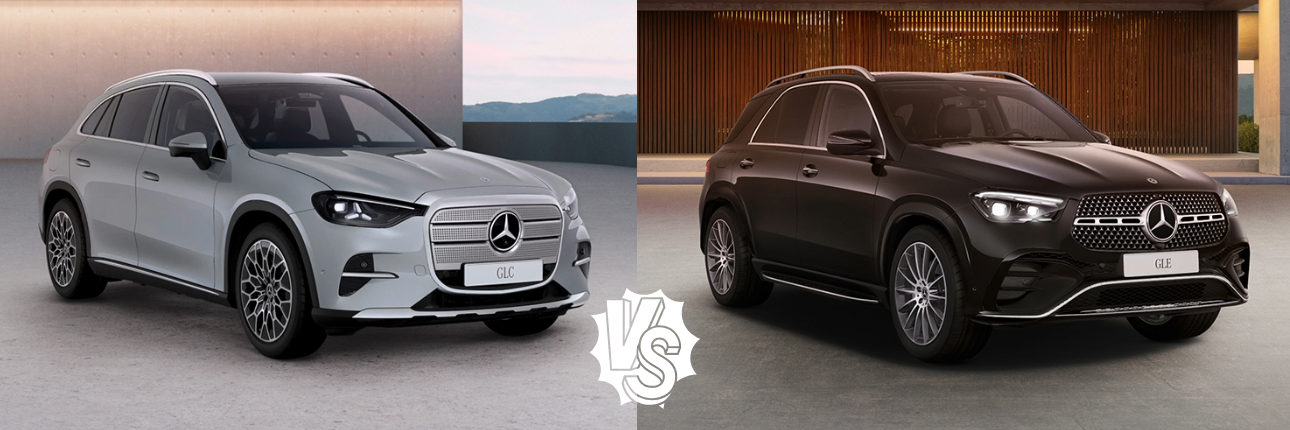
Mercedes-Benz GLC vs Mercedes-Benz GLE
01 May 2026
When it comes to luxury SUVs, Mercedes‑Benz offers a wide range of options that cater to different needs and lifestyles. Two of the most popular choices in the UK line-up are the Mercedes‑Benz GLC and the Mercedes‑Benz GLE. While both models deliver premium comfort, advanced technology and strong performance, key differences in size, space and capability can influence which one is right for you. Let’s explore how the GLC and GLE compare to help you make an informed decision.
Size and dimensions
The most noticeable difference between the Mercedes‑Benz GLC and Mercedes‑Benz GLE is their size. The GLC is a midsize, compact luxury SUV, making it easier to manoeuvre in urban environments and multi‑storey car parks while still offering impressive interior space. The current GLC measures 4.7 meters in length, with a wheelbase of nearly three meters. Depending on engine choice, kerb weight ranges from approximately 1,770 kg for petrol and diesel models to just over 2,100 kg for plug‑in hybrid variants.
The GLE, by comparison, is a full midsize luxury SUV with a larger footprint and a stronger road presence. It measures just under five meters in length, depending on specification, with a longer wheelbase just shy of three meters. Kerb weight typically ranges from around 2,250 kg for diesel models to approximately 2,570 kg for plug‑in hybrid versions. The added size translates into more cabin space and greater overall versatility.
Seating and comfort
Both the GLC and GLE feature Mercedes‑Benz’s latest MBUX infotainment system, high-quality materials and advanced driver assistance technologies, ensuring a premium driving experience across the range. However, there are important differences in seating and practicality.
The GLC is available exclusively with two rows of seating, accommodating up to five passengers. Boot space is generous for its class, offering up to 620 litres in petrol and diesel models, although this is reduced in plug-in hybrid variants due to the battery placement. This makes the GLC well-suited to couples, professionals or smaller families who prioritise comfort and efficiency.
The GLE offers greater flexibility. While five seat layouts are standard, UK buyers can specify an optional third row of seats, increasing passenger capacity to seven. With five seats in place, boot capacity stands at around 630 litres, expanding to over 2,000 litres when seats are folded. This makes the GLE a more practical choice for larger families or those who frequently travel with additional passengers.
Performance and engine options
Both models offer a wide selection of powertrains, but the GLE range includes more powerful and higher‑performance options. The Mercedes‑Benz GLC is available with petrol, diesel, mild hybrid and plug‑in hybrid engines. One of the most popular UK choices is the GLC 220 d, which delivers 197 hp from a 2.0‑litre diesel engine and balances strong performance with fuel efficiency. Plug‑in hybrid versions such as the GLC 300 e and 300 de offer electric‑only driving capability for shorter journeys. At the top of the range, performance enthusiasts can opt for the AMG GLC models, including the GLC 63 S E PERFORMANCE with outputs of up to 671 hp.
The Mercedes‑Benz GLE also offers petrol, diesel, mild‑hybrid and plug‑in hybrid options, but with greater emphasis on power and capability. Popular models include the GLE 300 d and the GLE 450 d, the latter featuring a smooth and powerful 3.0‑litre inline six diesel engine. Plug‑in hybrid versions such as the GLE 350 de and GLE 400 e combine strong performance with improved efficiency. The range‑topping AMG GLE 63 S delivers over 600 hp, offering exceptional performance for an SUV of this size.
Trim levels
The Mercedes‑Benz GLC is offered in Urban Edition, AMG Line, AMG Line Premium and AMG Line Premium Plus trims, along with high-performance AMG derivatives including the GLC 43 and GLC 63 S E PERFORMANCE.
The Mercedes‑Benz GLE is available in Urban Edition, AMG Line Premium and AMG Line Premium Plus trims, with AMG versions such as the GLE 53 and GLE 63 S providing enhanced performance and styling.
Fuel efficiency
In terms of fuel efficiency, the GLC holds an advantage over the larger GLE. Diesel versions such as the GLC 220 d can achieve up to 53.3 mpg (WLTP combined), making it a more economical option for everyday driving. Plug‑in hybrid GLC models offer very high WLTP combined figures when driven with regular charging and can provide up to around 80 miles of electric only range.
Due to its larger size and weight, the GLE is less efficient overall. The GLE 300 d returns up to approximately 41.5 mpg, while plug-in hybrid versions offer strong efficiency figures and an electric‑only range of around 60 miles. For drivers prioritising lower fuel and running costs, the GLC remains the more economical choice.
Towing capacity
If towing capability is a priority, the GLE clearly has the advantage. The Mercedes‑Benz GLC can tow up to 2,500 kg depending on model and configuration, which is sufficient for many trailers and caravans. The Mercedes‑Benz GLE increases this capacity to up to 2,700 kg across most variants, while high-performance models such as the AMG GLE 63 S can tow up to 3,500 kg. This makes the GLE better suited to heavier towing requirements, including boats and horseboxes.
Conclusion
Both the Mercedes‑Benz GLC and GLE are excellent luxury SUVs, each offering their own strengths. The GLC is ideal for drivers seeking a more compact, efficient and easier to drive premium SUV, particularly suited to urban use and lower running costs. In contrast, the GLE delivers greater interior space, higher towing capacity and more powerful engine options, making it the better choice for larger families or those who need maximum versatility and performance.
Both are outstanding luxury SUVs - the right choice simply depends on your lifestyle.